
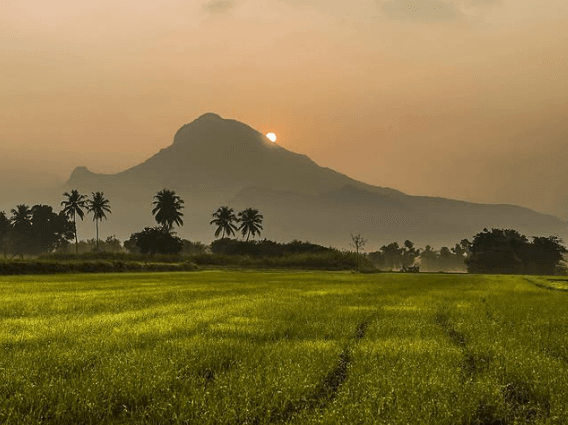
Image by Saran Dashnamoorthy (C) Arunachalarts
“That first breath of Indian air carried something ancient—something that recognized me before I recognized it.”
That feeling of being strangely at home in India never left me. What began as curiosity soon deepened into a soul connection that kept calling me back again and again. Each visit drew me closer to the sacred heart of the South, to the holy mountain Arunachala—a place where silence itself seems to speak.
Deepening Roots in the South
That first month‑long stay south of Bangalore was followed by visits to Tiruvannamalai along with trips to Mysore and Bangalore city.
Over the next decade I spent more time in Bangalore, Tiruvannamalai, exploring Pondicherry, Vellore, Poondi, Tirupati, and even the Kumbha Mela in Ujjain.
Though I visited only a few places, my time at the feet of Arunachala brought a deep understanding of South Indian culture.
The Arunachala Experience
As part of this blog I share stories and experiences gathered from nearly six years in India. Some are funny, others astonishing or deeply touching.
In India—as anywhere in the world—life is best understood from a higher perspective, where events and people mirror our own inner landscape, offering infinite chances to grow and awaken.
“Arunachala is not a symbol but a living presence—a reminder that wisdom, like the mountain, never moves.”
The Greeting of Arunachalam
A common greeting in India is Namaste, meaning “I bow to the Divine or Self in you,” offered with both hands joined before the chest.
In Tiruvannamalai, I often encountered another gesture: touching the heart center with the right hand and giving a gentle nod while saying Arunachalam or Namah Shivaya. It honors Lord Shiva in the form of the sacred Arunachala Mountain.
The Legend of Arunachala
Once, Brahma the Creator and Vishnu the Preserver argued over who was greatest among them. They turned to Lord Shiva, who appeared as a vast column of fire. He invited them to find His head and feet, but neither could. Thus Shiva revealed Himself as the Supreme.
That column of fire cooled and became the Arunachala Mountain, now revered as a living embodiment of Lord Shiva.
Geologists say Arunachala was once an active volcano, thousands of years old—older even than the Himalayas.
The Meaning of the Name
“Aruna means ‘red,’ bright like fire. But this is no ordinary fire—it is Jnanagni, the Fire of Wisdom. Achala means ‘immovable hill.’ Thus, Arunachala means ‘the Hill of Wisdom.’”
— Talks with Sri Ramana Maharshi, Talk 216
Come Along
Come join me on this spiritual pilgrimage. Feel the timeless power of Arunachala. Let its silent fire awaken the wisdom within.